
Tree Service in King William Historic District, San Antonio — Heritage Trees, Permits & Certified Arborists
Home › Service Areas › Tree Service King William District San Antonio
Got a 100-year-old oak dropping branches onto your Victorian-era porch — and no idea whether you need a permit before calling anyone? That’s the exact situation King William District homeowners face, and it’s why tree work in 78204 is different from anywhere else in San Antonio. JCS Trees knows this neighborhood’s rules, its trees, and its history. Our ISA-certified arborists work within San Antonio’s Heritage Tree Ordinance and coordinate with the Office of Historic Preservation when removals require it — so your trees get proper care and your property stays fully compliant.
What Tree Service Company Handles Heritage Trees in King William District, San Antonio?
JCS Trees provides ISA-certified tree care throughout King William Historic District, ZIP 78204. Our arborists are experienced with San Antonio’s Heritage Tree Ordinance, the city’s tree permit process through the BuildSA portal, and Office of Historic Preservation coordination for protected trees — plus full oak wilt treatment, ball moss removal, and 24/7 emergency response.
Permit requirements and fees vary by tree size and location. Always confirm with the City of San Antonio’s Development Services Department before any removal.
WHAT MAKES KING WILLIAM TREE CARE DIFFERENT
Tree Care in King William District Is Not Like Anywhere Else in San Antonio
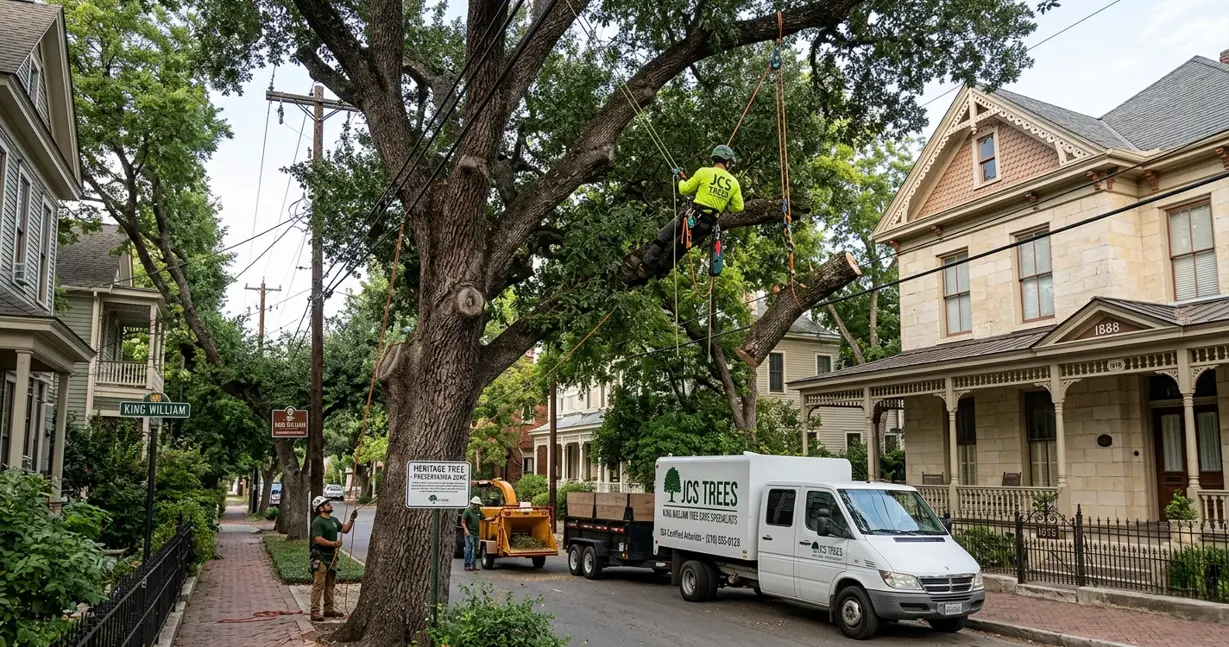
King William is San Antonio’s oldest residential neighborhood — a 25-block historic district listed on the National Register of Historic Places since 1972. The German merchant mansions built here between the 1850s and 1890s were designed around sweeping tree canopies. Those trees are still here. Many are well over 100 years old, and several qualify as heritage trees under San Antonio’s tree preservation ordinance.
Under the City of San Antonio’s UDC Chapter 35, Section 523, a heritage tree is defined as any tree with a trunk diameter of 24 inches or more. Removing, severely pruning, or damaging a heritage tree without a city-issued tree permit is a violation that carries significant penalties. In King William — where almost every large oak, pecan, and cedar elm on the property could qualify — this matters on nearly every job.
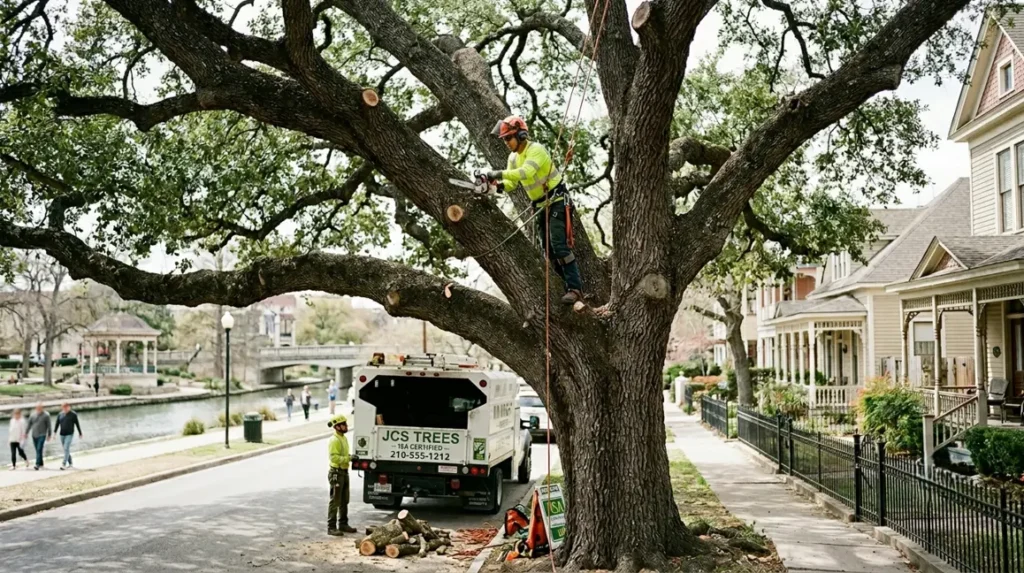
Beyond permit requirements, the narrow streets of King William, the density of adjacent mansions, and the presence of overhead utility lines along many blocks add real technical challenges to every removal or major trim. A tree that could be felled in a single straight drop on a suburban lot requires careful sectional rigging here to avoid damaging a 140-year-old fence, a neighbor’s roof, or a historic carriage house.
JCS Trees handles all of this as part of our standard King William service — permit identification, removal coordination with the City of San Antonio’s Office of Historic Preservation, and technically precise work in tight, historically sensitive spaces.
COMMON TREE PROBLEMS IN KING WILLIAM DISTRICT 78204
What JCS Trees Sees Most Often in King William Historic District
- Heritage tree limb failure — trees over 100 years old develop internal decay that isn’t visible from the ground; sudden limb drops are a recurring hazard on King William’s narrow sidewalks and adjacent properties
- Oak wilt in century-old live oaks — older trees with reduced immune response are more vulnerable; underground root connections between neighboring mansions can spread the disease quickly through the entire block
- Ball moss on pecan and elm canopies — King William’s high-humidity microclimate near the San Antonio River makes ball moss particularly aggressive on the neighborhood’s large pecan and cedar elm trees
- Root heaving on historic sidewalks and foundations — century-old root systems have lifted walkways, cracked historic masonry, and created tripping hazards along the King William River Walk
- Storm-damaged limbs over Victorian-era rooftops — large overhang branches from street trees frequently cause damage to historic copper gutters and slate or tile roof sections
- Tight access for equipment — King William’s narrow streets and alley systems require crews with compact equipment and rigging expertise rather than standard bucket trucks
Permit delays on time-sensitive hazards — when a heritage tree becomes a safety hazard, navigating the city permit process quickly requires experience with the BuildSA portal and Development Services staff
- From Concept to Creation
COMMON TREE PROBLEMS IN KING WILLIAM DISTRICT 78204
What JCS Trees Sees Most Often in King William Historic District
- Heritage tree limb failure — trees over 100 years old develop internal decay that isn’t visible from the ground; sudden limb drops are a recurring hazard on King William’s narrow sidewalks and adjacent properties
- Oak wilt in century-old live oaks — older trees with reduced immune response are more vulnerable; underground root connections between neighboring mansions can spread the disease quickly through the entire block
- Ball moss on pecan and elm canopies — King William’s high-humidity microclimate near the San Antonio River makes ball moss particularly aggressive on the neighborhood’s large pecan and cedar elm trees
- Root heaving on historic sidewalks and foundations — century-old root systems have lifted walkways, cracked historic masonry, and created tripping hazards along the King William River Walk
- Storm-damaged limbs over Victorian-era rooftops — large overhang branches from street trees frequently cause damage to historic copper gutters and slate or tile roof sections
- Tight access for equipment — King William’s narrow streets and alley systems require crews with compact equipment and rigging expertise rather than standard bucket trucks
Permit delays on time-sensitive hazards — when a heritage tree becomes a safety hazard, navigating the city permit process quickly requires experience with the BuildSA portal and Development Services staff
WHY KING WILLIAM HOMEOWNERS CHOOSE JCS TREES
We know the permit process — not just the trees. Most tree companies in San Antonio can trim a live oak. Very few understand San Antonio’s Heritage Tree Ordinance well enough to guide a King William homeowner through a removal permit application correctly. We’ve done it. We know what exhibits the BuildSA portal requires, when to coordinate with the Office of Historic Preservation, and how to document a hazard tree case that supports an expedited permit.
ISA Tree Risk Assessment Qualified for heritage hazard documentation. Our TRAQ-certified arborist can provide a formal written Tree Risk Assessment — which is exactly the kind of documentation the City’s Development Services Department wants to see when a heritage tree must be removed on safety grounds. This report can mean the difference between a permit granted in days vs. weeks.
Texas Oak Wilt Certified — critical in a neighborhood this old. King William’s interconnected root systems between century-old oaks create some of the highest underground oak wilt transmission risk in all of San Antonio. Our Texas Oak Wilt Certified arborists follow the San Antonio Oak Wilt Ordinance (Ch. 21, Sec. 170) on every job — wounds painted within 30 minutes, proper seasonal timing observed, no infected wood transported.
Equipment matched to historic district access. We don’t show up to a King William job with oversized equipment that can’t navigate Guenther Street or Madison Street. Our compact aerial units and rigging systems are chosen for tight urban historic work — protecting cobblestone walkways, iron fencing, and adjacent mansion facades throughout the process.
Written estimates, photo documentation, permit paperwork support. Every King William estimate includes a scope of work document suitable for HOA or city permit submission.
Tree Services We Provide in King William Historic District, San Antonio
Tree Removal — King William District
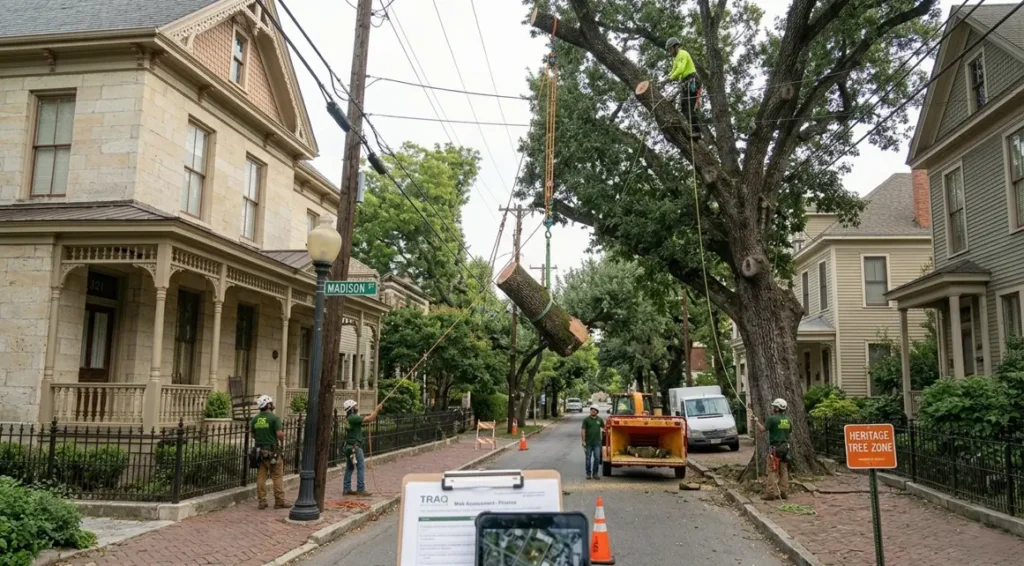
Removing a tree in King William is never a simple job. The narrow streets, adjacent Victorian mansions, overhead utility lines along Madison and Guenther Streets, and the presence of heritage-designated trees make every removal a planned operation — not just a cut-and-drop. Our ISA-certified crew assesses site access, identifies any heritage tree permit requirements through the San Antonio BuildSA portal, and uses controlled sectional rigging to bring down large trees without touching historic iron fencing, cobblestone walkways, or neighboring 140-year-old structures.
If your tree qualifies as a heritage tree — 24 inches or more in trunk diameter — we handle the permit documentation, coordinate with the Office of Historic Preservation if your property carries an “H” designation, and provide the TRAQ risk assessment report the city needs to process your application. No other King William tree removal service offers this level of end-to-end compliance support. Explore our full tree removal service for complete process details.
Tree Removal — King William District
Removing a tree in King William is never a simple job. The narrow streets, adjacent Victorian mansions, overhead utility lines along Madison and Guenther Streets, and the presence of heritage-designated trees make every removal a planned operation — not just a cut-and-drop. Our ISA-certified crew assesses site access, identifies any heritage tree permit requirements through the San Antonio BuildSA portal, and uses controlled sectional rigging to bring down large trees without touching historic iron fencing, cobblestone walkways, or neighboring 140-year-old structures.
If your tree qualifies as a heritage tree — 24 inches or more in trunk diameter — we handle the permit documentation, coordinate with the Office of Historic Preservation if your property carries an “H” designation, and provide the TRAQ risk assessment report the city needs to process your application. No other King William tree removal service offers this level of end-to-end compliance support. Explore our full tree removal service for complete process details.
Tree Trimming — King William District
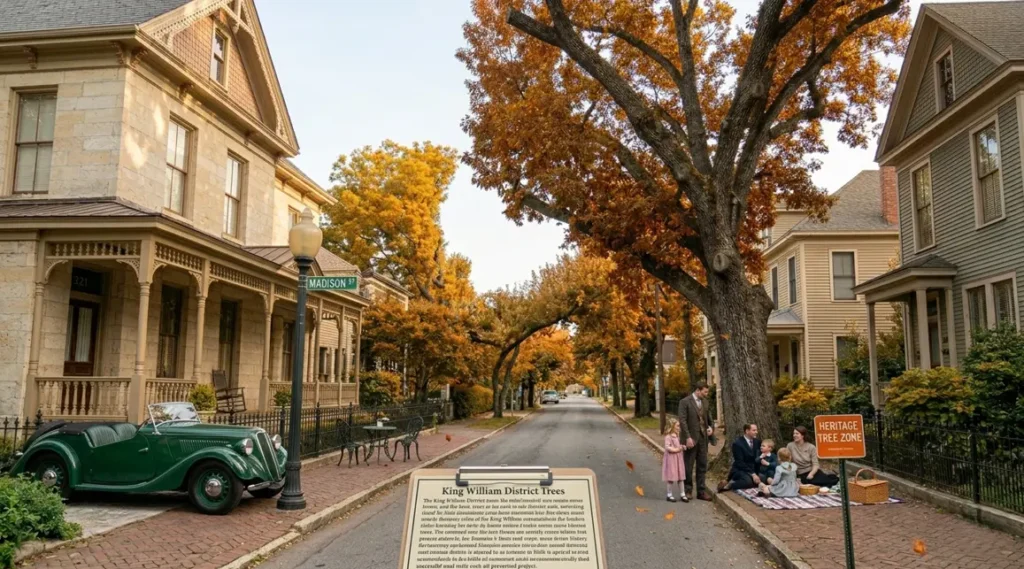
King William’s century-old live oaks and pecans don’t need aggressive trimming — they need precise, arborist-guided canopy management that removes what threatens the tree’s structure while preserving the full, spreading shape that defines these historic streetscapes. Our trimming work in 78204 follows San Antonio’s Oak Wilt Ordinance (Ch. 21, Sec. 170) strictly — every cut on a live oak is sealed with wound paint within 30 minutes, and we schedule oak trimming within the July 1 to January 31 safe window wherever possible.
For King William’s pecan trees — some of them planted when the German merchant mansions were first built — we time trimming to late winter, before bud break, when the tree’s energy is stored in the root system and pruning wounds heal fastest. Our tree trimming service covers every species common to the King William canopy.
Tree Pruning — King William District
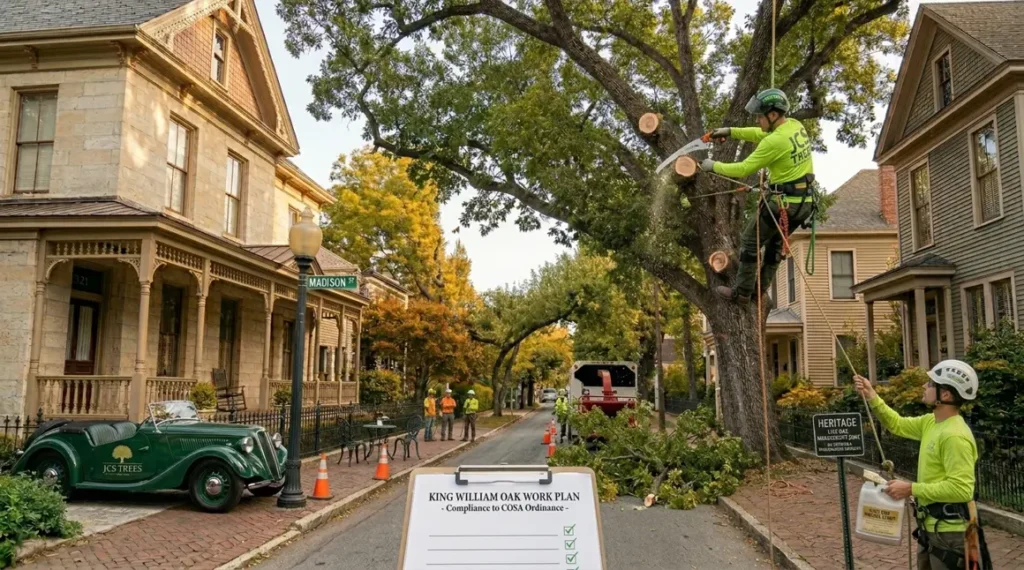
Pruning a 110-year-old live oak in King William requires a different mindset than routine trimming. At this age, the structural decisions you make today — which co-dominant stem to reduce, which lateral limb to cable-brace rather than remove — will determine whether that tree stands for another 50 years or becomes a hazard requiring a heritage tree permit within a decade. Our ISA Certified Arborists prune King William’s oldest trees with long-term structure as the primary goal, using ANSI A300 pruning standards on every job.
For properties near the King William River Walk, Bandstand, and Johnson Street pedestrian bridge — where large tree canopies hang over public walkways — we also provide written crown condition reports that document the pruning rationale, useful for historic preservation records and insurance files. Visit our tree pruning service page for full detail.
Ball Moss Removal — King William District
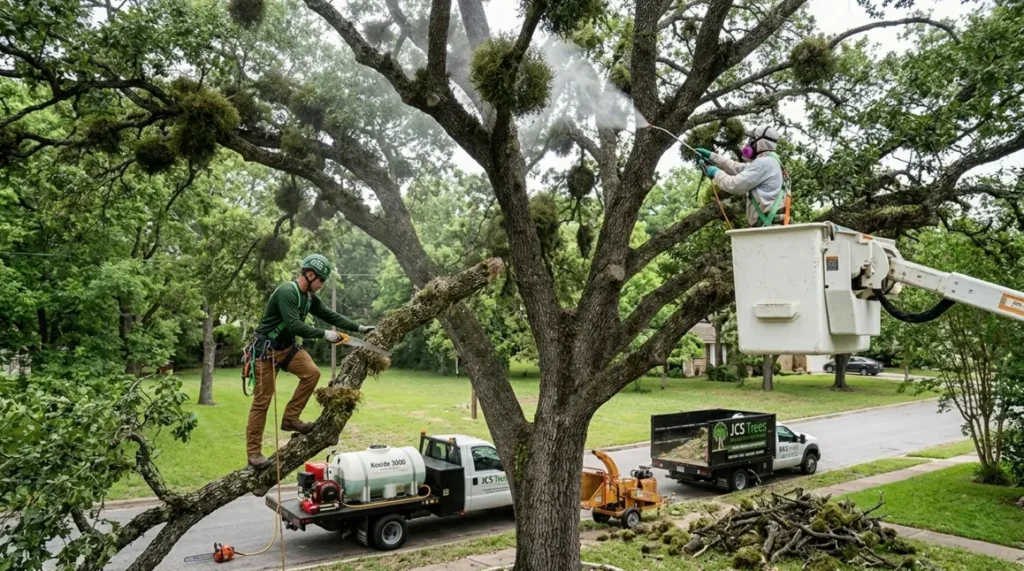
The microclimate along the San Antonio River through King William creates conditions that accelerate ball moss growth on the neighborhood’s large pecans and cedar elms. Reduced airflow between tightly spaced historic mansions and the added humidity from the river corridor mean that ball moss builds faster here than in most San Antonio neighborhoods — and on trees that are already managing age-related stress, that extra burden matters.
Our ball moss removal in King William combines careful manual removal from historic canopy trees — using rigging techniques that protect adjacent structures throughout — with a preventative broadcast spray treatment that slows regrowth. For trees near the river or in particularly shaded interior lots, we recommend biennial maintenance to stay ahead of reinfestation. Our ball moss removal service covers all treatment options.
Stump Grinding — King William District
Stump grinding in King William’s tight urban environment requires compact equipment that can navigate carriage entrances, historic cobblestone driveways, and the narrow side yards common to 19th-century mansion lots. Standard residential grinding equipment often can’t access the spaces where King William stumps sit. We bring compact grinding units specifically suited to urban historic properties — grinding to 6 to 8 inches below grade and cleaning the surface flat, ready for resodding, replanting, or paving over.
For properties where a heritage tree removal required a city permit, we provide written stump removal completion documentation that closes out the permit file with the city’s Development Services Department.
Stump Removal — King William District
Full stump extraction — removing the entire root ball rather than just grinding the above-grade portion — is the right choice in King William when root systems from removed heritage trees are extensive enough to continue affecting neighboring structures or underground infrastructure. Century-old root systems from large pecans and live oaks can extend 40 to 60 feet from the original trunk location, intersecting with historic masonry foundations, cast-iron sewer lines, and the root zones of adjacent trees.
Our stump removal service includes a site assessment to determine whether grinding or full extraction is the appropriate recommendation for your specific King William property — and we give you a clear explanation of both options before you decide.
Land Clearing — King William District
Land clearing in King William typically involves smaller-scale lot work rather than large acreage — clearing overgrown rear courtyard sections, removing established brush lines along historic boundary walls, or clearing vegetation from properties undergoing preservation renovation. We work carefully around historic masonry, original brick and stone boundary walls, and protected mature trees on adjacent properties.
For King William properties undergoing historic rehabilitation — where landscape restoration is part of a larger preservation project — our land clearing service provides the clean site prep needed before new period-appropriate planting begins.
Emergency Tree Service — King William District, 24/7
When a storm moves through the King William River Walk corridor at 2 am and drops a large pecan limb across your carriage house or onto the adjacent public walkway, the situation requires immediate professional response — not because of the inconvenience, but because historic properties carry specific liability when tree debris affects neighboring structures or public access areas.
JCS Trees dispatches emergency crews to King William Historic District around the clock, every day of the year. We photograph every emergency job for insurance documentation, provide written scope-of-work records, and coordinate with neighboring property owners or the city when debris affects shared spaces. Our emergency tree service is available at (210) 880-3742 — always a real person, never a voicemail.
3-STEP PROCESS — KING WILLIAM
First — we assess the tree AND the rules that apply to it. Before we quote any King William job, we check whether the tree meets the heritage threshold (24″ diameter), whether the property has an “H” historic designation in the city’s GIS system, and what permit or coordination is needed. You don’t want a surprise stop-work order halfway through a removal.
Then — we work within the historic district’s constraints. Narrow streets, neighboring mansions, overhead lines, iron fencing, and slate roofs all factor into how our crew sets up and executes the job. We rig, section, and lower — we don’t just cut and drop.
Finally — cleanup and compliance documentation. We clean the site completely and provide written completion documentation including photos, scope of work, and any permit closure paperwork required by the city. King William homeowners dealing with preservation easements or historic landmark designations get the paper trail they need.
COVERAGE — KING WILLIAM DISTRICT & NEARBY
JCS Trees covers all of King William Historic District across ZIP code 78204, including properties along King William Street, Guenther Street, Madison Street, Adams Street, and the Johnson Street River Walk corridor. We also serve neighboring South Town, Lavaca, and the King William River Walk residential sections.
Our work in King William frequently connects to jobs in nearby Monte Vista and Terrell Hills — two more San Antonio neighborhoods where mature canopies and historic property considerations require the same level of care.
Also serving: Downtown San Antonio, South Town, Lavaca, and surrounding Bexar County communities.
FAQs — KING WILLIAM DISTRICT TREE SERVICE
Q: Do I need a permit to remove a tree in King William Historic District?
Possibly yes — and in King William, the answer matters more than almost anywhere else in San Antonio. If the tree trunk measures 24 inches or more in diameter, it qualifies as a heritage tree under the City of San Antonio’s Tree Preservation Ordinance (UDC Ch. 35, Sec. 523), and removal requires a city-issued tree permit through the BuildSA portal. Additionally, if your property carries an “H” historic designation — which many King William lots do — tree removal must be coordinated with the City’s Office of Historic Preservation. JCS Trees guides homeowners through both processes as part of our service.
Q: What is a heritage tree in San Antonio, TX?
Under San Antonio’s tree preservation ordinance, a heritage tree is any tree with a trunk diameter at breast height (DBH) of 24 inches or more. Common King William heritage trees include large live oaks, pecan trees, and century-old cedar elms. Heritage trees cannot be removed without a permit, and causing damage to one — including through improper pruning — can result in mitigation requirements from the city. Our ISA Tree Risk Assessment Qualified arborist can formally document a heritage tree’s condition if permit documentation is needed.
Q: Can any tree company work in King William, or do they need a special license?
In San Antonio, any contractor performing tree pruning or trimming must hold a valid City of San Antonio Tree Maintenance License. This requires documented continuing education credits and compliance with the city’s Oak Wilt Ordinance. For work involving heritage trees or properties with historic designations, additional coordination with city offices is required. JCS Trees holds all required licensing and has direct experience working within King William’s regulatory framework.
Q: How do I know if oak wilt is spreading to my King William trees?
Look for these signs on your live oaks: leaves browning from the tips inward (called veinal necrosis), yellowing along leaf veins, and rapid leaf drop during spring or summer growing season. In King William, where century-old oaks often share interconnected root systems with neighboring properties, a single infected tree can spread oak wilt underground across an entire block. The San Antonio Oak Wilt Ordinance (Ch. 21, Sec. 170) requires all oak wounds to be sealed within 30 minutes. Our Texas Oak Wilt Certified team responds quickly — call (210) 880-3742 if you suspect infection.
Q: How much does tree removal cost in King William Historic District?
Standard non-heritage removals in King William typically run $400 to $1,800, reflecting the tight access, rigging requirements, and urban complexity. Heritage tree removals requiring permits can range from $800 to $3,500 or more depending on tree size, permit timeline, and site access. JCS Trees provides free written estimates with scope-of-work documentation included — suitable for city permit submissions and insurance purposes.
- About
Why King William Homeowners Trust JCS Trees With Their Historic Properties
King William’s trees are not replaceable. A 130-year-old pecan or a century-old live oak that shades a Victorian mansion cannot be regrown in a homeowner’s lifetime — which is why every decision our team makes in this neighborhood is approached with extra care and full regulatory awareness. Our ISA Certified Arborist credential, Texas Oak Wilt Certification, and ISA Tree Risk Assessment Qualification are not just marketing badges here — they are the minimum standard for responsible work in a protected historic district.
We carry full general liability insurance and workers’ compensation on every job, and we provide written proof of insurance before work begins at any King William property. Our crew arrives in marked vehicles, carries photo ID, and documents the job from start to finish — giving historic homeowners a complete record for preservation easements, insurance claims, or city compliance files.
1
ISA Certified Arborist
Our arborists hold active ISA Certified Arborist credentials, the tree care industry’s most recognized professional standard, earned through rigorous examination and ongoing continuing education requirements set by the International Society of Arboriculture.
2
Texas Oak Wilt Certified
Our team carries Texas Oak Wilt Certification, meaning every arborist on your job understands how to correctly diagnose, treat, and stop the spread of oak wilt — the deadliest tree disease in Texas — before it moves underground to neighboring trees on your street.
3
ISA TRAQ
Our TRAQ-certified arborist conducts formal written tree risk assessments that document structural condition, failure probability, and recommended action — the kind of report your insurance company, HOA, or city permit office actually accepts as professional documentation.
4
City of San Antonio Tree Maintenance License
Every crew member working on your trees holds a valid City of San Antonio Tree Maintenance License, which requires documented continuing education credits, Oak Wilt Ordinance compliance training, and approval from the City Arborist — so you know the person touching your trees is legally authorized to do so in San Antonio.
TESTIMONIALS
“We have a live oak in front of our Madison Street home that qualifies as a heritage tree. JCS Trees walked us through the entire permit process, submitted the risk documentation, and completed the trimming without a single scratch to our iron fence or the historic sidewalk. Truly professional.”
— Robert & Claire F., King William Street, 78204
“After the last storm, a large pecan limb came down on our carriage house roof. JCS Trees was out within three hours, rigged the remaining split limb off the building safely, and gave us a full photo report for the insurance claim. No other company would have been as careful in a space that tight.”
— Patricia H., Guenther Street, King William District
Heritage Oak Wilt Intervention — Adams Street, King William District
The situation: A homeowner on Adams Street had a 110-year-old live oak showing advanced oak wilt symptoms — rapid defoliation in April, brown veinal streaking on remaining leaves. Two neighboring oaks on adjacent mansion properties shared the same root zone.
What we did: Our Texas Oak Wilt Certified arborist confirmed the diagnosis, coordinated with the homeowner’s neighbor, trenched a 100-foot root barrier between the infected tree and the two healthy adjacent oaks, removed the infected tree under a city-issued heritage tree permit, and treated the neighboring trees with preventative fungicide.
The outcome: Both neighboring century-old oaks survived. The infected tree was legally removed without penalty. The homeowner received a complete permit file and photo record — saving an estimated $18,000 in potential mitigation requirements if the work had been done without proper permits.
Serving the Entire King William Historic District — From Bandstand to Johnson Street Bridge
JCS Trees serves King William Historic District from the King William Park Bandstand to the Johnson Street pedestrian bridge — call ahead and we’ll confirm access logistics for your specific address.