
Professional Ball Moss Removal San Antonio, TX
“Why do my San Antonio trees look so gray and fuzzy?” If that question brought you here, you’re in the right place. Those rough, ball-shaped clumps clinging to your live oaks are ball moss — and JCS Trees removes them safely across all San Antonio neighborhoods, from Stone Oak down to properties near the River Walk. We’re available 24/7, ISA-certified, and ready to restore your trees today.
Which Is the Best and Affordable Ball Moss Removal Service in San Antonio, TX?
JCS Trees is San Antonio’s trusted choice for professional ball moss removal, serving ZIP codes 78201 through 78299, 24/7. Our ISA-certified arborists handle chemical treatment, manual removal, and combined pruning packages. Pricing typically ranges from $150 to $2,500 depending on tree size and severity. Free estimates available — no hidden fees.
Prices vary by tree size, infestation level, and method selected; confirm exact cost before work begins.
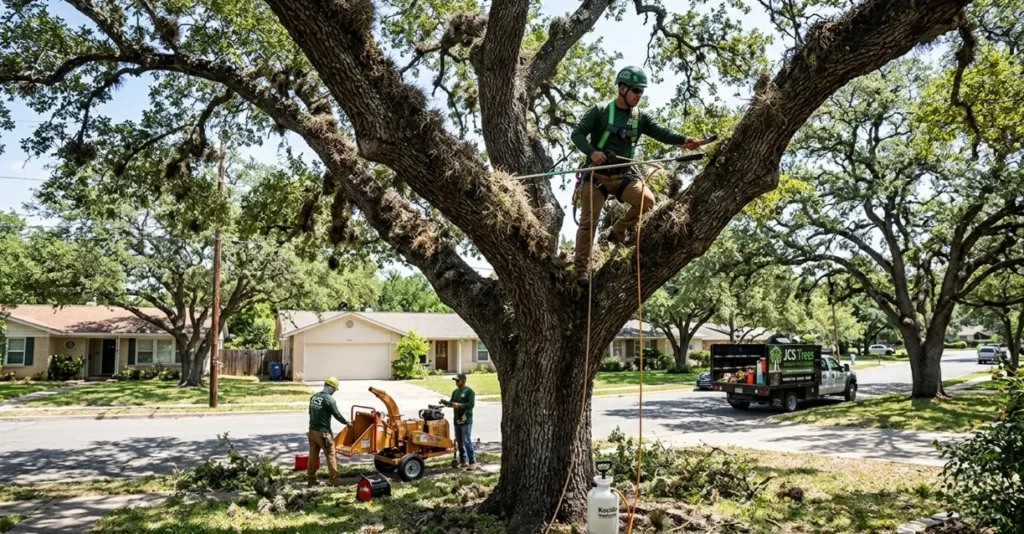
What Is Ball Moss and Why Does It Grow on San Antonio Trees?
Ball moss (Tillandsia recurvata) is a small, gray-green air plant that belongs to the bromeliad family — the same plant family as pineapples. Despite its name, it is not actually a moss at all. It is an epiphyte, meaning it attaches to trees, fences, and even power lines purely for physical support. It does not root into the tree or steal water and nutrients from it.
So why does San Antonio have so much of it? Because ball moss thrives in exactly the conditions our city delivers: high humidity, warm temperatures, and the dense, shaded lower canopy of live oak trees. The inner branches of a mature live oak — where air circulation is minimal — are the perfect home for ball moss to anchor, multiply, and spread. When conditions are right, a single tree can become overwhelmed within a few seasons.
Ball moss is frequently confused with Spanish moss (Tillandsia usneoides), which hangs in long curtains and is more common along the Gulf Coast and East Texas. Ball moss forms compact, rounded clumps that attach directly to individual branches. Neither is a true moss, and neither is a parasite — but they are very different plants in appearance and growth habit.
It is also commonly mistaken for mistletoe, and this distinction matters. Mistletoe is a true parasite that draws water and nutrients directly from the tree. Left alone, mistletoe will spread throughout the canopy and can eventually kill the tree. Ball moss will not kill a tree on its own — but it creates conditions that lead to branch decline, and heavy infestations come with real risks that homeowners in Alamo Heights, Stone Oak, and Olmos Park should not ignore.
Looking for complete tree care beyond ball moss? Explore our full San Antonio tree services to see everything we offer.
Is Ball Moss Actually Harmful? Here Is the Honest Answer.
This is the most common question homeowners ask, and the honest answer is: it depends on how bad the infestation is.
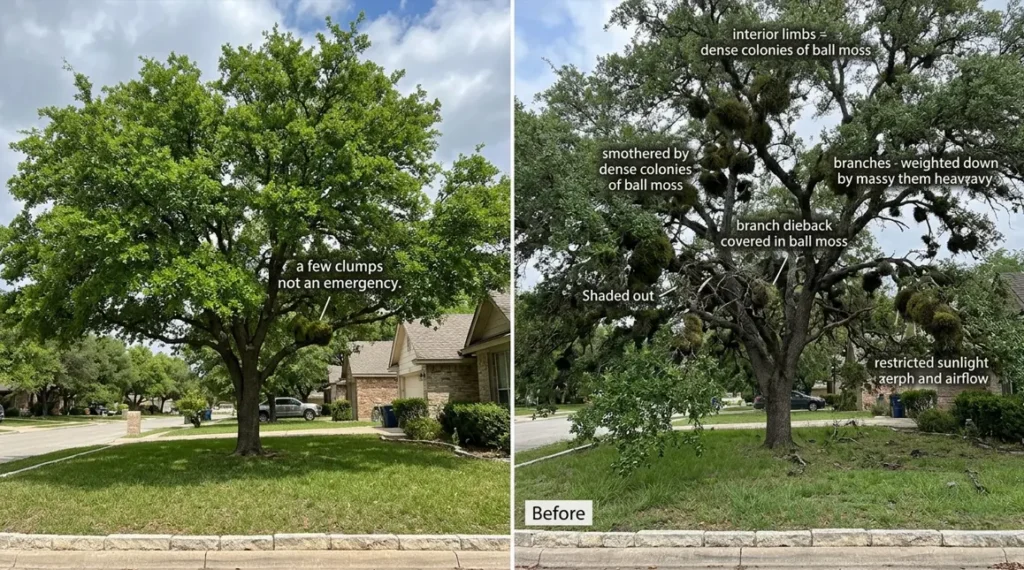
A few clumps of ball moss on a healthy, well-maintained live oak? Not an emergency. A tree smothered in dense colonies of ball moss with restricted canopy airflow, weighted-down branches, and dying interior limbs? That is a problem worth addressing now.
Here is what happens when ball moss is left untreated:
- Restricted sunlight and airflow. Dense clusters shade out the buds and young leaves on interior branches, slowing or stopping leaf production on those limbs.
- Branch dieback. Over time, shaded branches that cannot photosynthesize begin to die. You will notice dead limbs covered in ball moss — and while the ball moss did not directly cause the death, it accelerated the decline.
- Dangerous branch weight. Ball moss absorbs moisture from the air. When wet after San Antonio’s spring rains, a heavily infested tree can carry significant extra weight, increasing the risk of branch failure.
- Reduced property value. San Antonio real estate professionals and home buyers interpret heavy ball moss as a sign of neglected tree care — even on otherwise healthy trees. Mature live oaks can add $10,000 to $30,000 or more to a property’s appraised value. Letting ball moss take over works against that investment.
- Pest harborage. Dense ball moss colonies provide cover for insects and ants that can further stress your trees.
The right time to remove ball moss is winter, while your trees are dormant and before spring buds emerge. This is also when oak wilt-carrying beetles are least active — an important consideration whenever pruning cuts are made on San Antonio oak trees (more on oak wilt below).
The Oak Wilt Connection: Why Ball Moss Removal Requires Extra Care
This is a critical piece of information that most ball moss removal pages in San Antonio skip entirely — and it can make the difference between a healthy tree and a dead one.
Oak wilt is one of the most destructive tree diseases in Texas. It is caused by the fungus Bretziella fagacearum and is spread by sap beetles that are attracted to fresh pruning wounds on oak trees. Live oaks — the same trees most commonly affected by ball moss in San Antonio — are highly susceptible.
When a crew removes ball moss, they typically prune branches at the same time to improve canopy airflow and remove deadwood. Every pruning cut is a fresh wound. Every fresh wound on a live oak must be painted immediately with wound-seal paint to prevent sap beetles from transmitting oak wilt.
At JCS Trees, our team is Texas Oak Wilt Certified. We follow the City of San Antonio’s oak wilt management guidelines on every job. We carry wound sealant on every truck, and we never leave a cut unpainted. This is not optional — it is standard practice on every ball moss removal we perform.
If you hire a crew that does not mention oak wilt during a ball moss removal estimate, ask them about it. The answer will tell you a great deal about their level of expertise.
After ball moss removal, protecting the long-term health of your oaks sometimes requires additional care. Learn how our San Antonio tree pruning services keep your canopy healthy year-round.
Service List
Ball Moss Removal Methods: What We Use and Why
Not all ball moss removal jobs are the same. The right method depends on the size of your trees, the severity of the infestation, and whether any other tree care work — pruning, deadwood removal, canopy thinning — needs to happen at the same time.
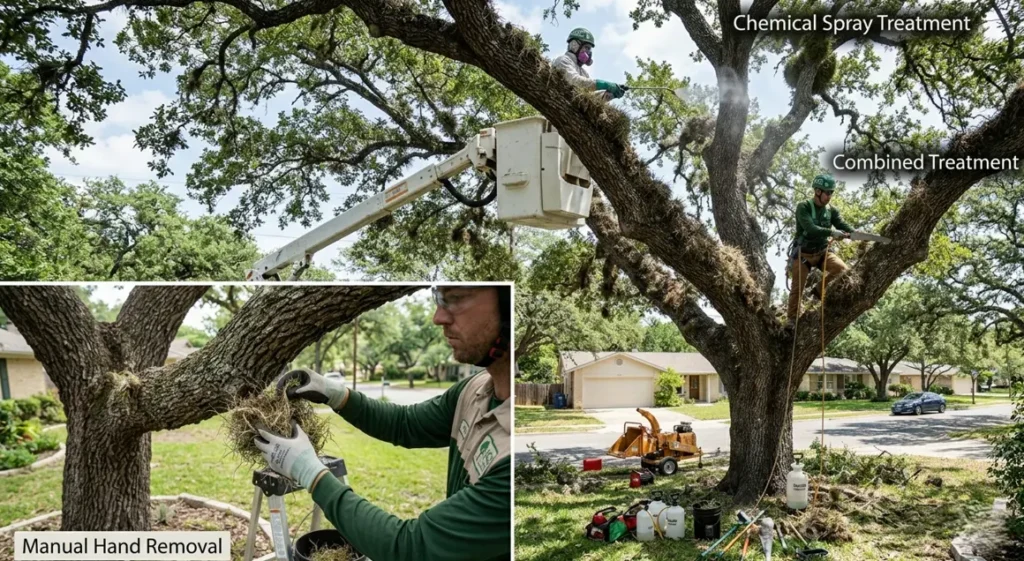
Manual Hand Removal
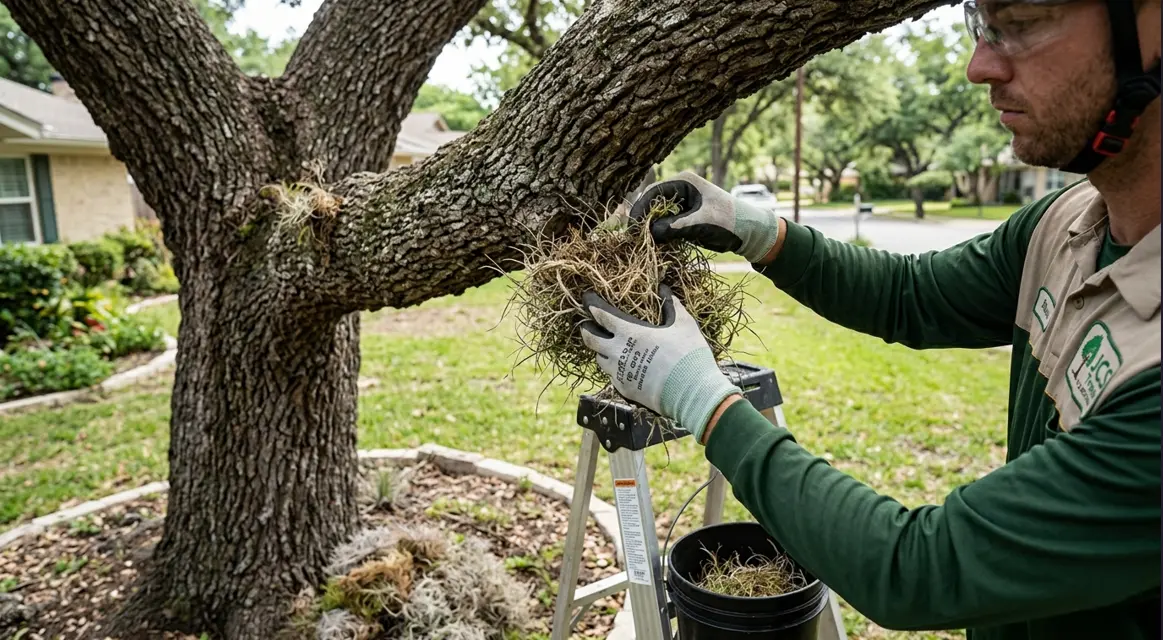
For small trees, accessible lower branches, or isolated clumps on larger trees, manual removal is the most precise option. Our crew physically removes each ball moss plant from the branch. The holdfasts are shallow — they do not penetrate the bark — so removal causes no damage to the tree. It is labor-intensive but chemical-free and highly targeted.
Best for: small infestations, low-hanging branches, homeowners who prefer no chemical exposure.
Chemical Spray Treatment (Kocide 3000)
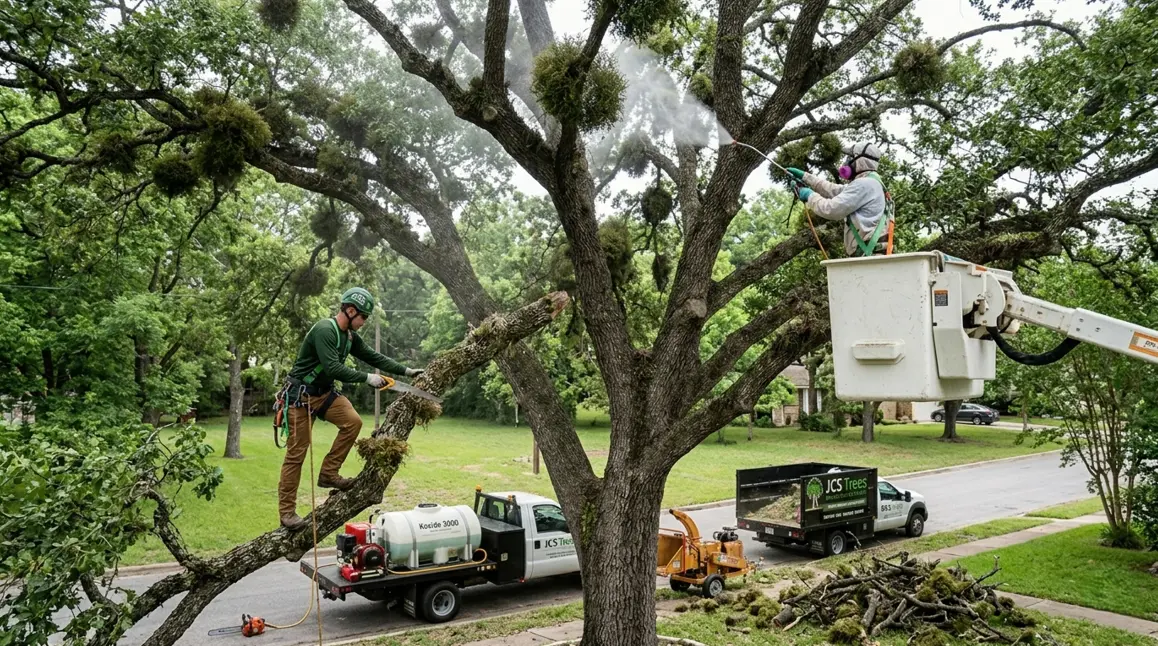
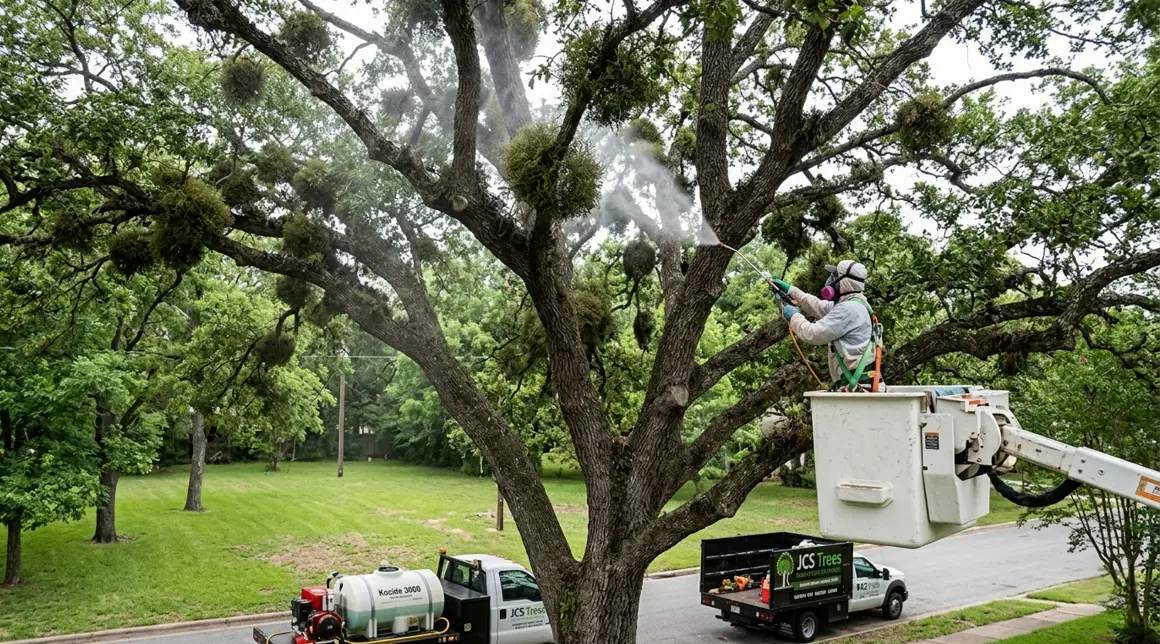
For larger trees and heavier infestations, the most effective treatment is spraying with a copper hydroxide fungicide, most commonly the product Kocide 3000. The spray kills the ball moss without harming the tree. The dead ball moss then dries out and falls from the branches over the following weeks.
Best for: tall trees, whole-canopy infestations, cost-effective per-tree treatment.
Combined Treatment + Pruning
This is our most recommended approach. We apply chemical treatment across the canopy and simultaneously remove deadwood and thin the canopy to improve air circulation — which is the single best long-term deterrent to ball moss regrowth. Pruning also removes the shaded, low-airflow interior branches where ball moss thrives most.
Best for: trees with heavy infestations and significant deadwood; optimal results and longest regrowth prevention.
Power Washing + Physical Removal
For certain situations — particularly smaller ornamental trees or trees near structures — a combination of power washing and physical removal can clear ball moss quickly without chemicals.
Why Choose JCS Trees for Ball Moss Removal in San Antonio?
When San Antonio homeowners search for ball moss removal, they want more than just a crew with a spray bottle — they want certified experts who understand live oaks, oak wilt risks, and what long-term tree health actually looks like. Here is exactly what sets JCS Trees apart.
ISA-Certified Arborist on every job.
Our team holds International Society of Arboriculture (ISA) certification — the gold standard in professional tree care. We do not send untrained crews to your property.
Texas Oak Wilt Certified.
We are one of the few San Antonio tree services that holds formal Texas oak wilt certification. This matters enormously on any job involving live oak pruning cuts.
ISA Tree Risk Assessment Qualified (TRAQ)
We assess structural risk, not just ball moss. If a branch is compromised, we identify it during the same visit.
No hidden fees. Written estimates always
- Every quote is provided in writing before work begins. What we quote is what you pay.
90-day workmanship guarantee
If any aspect of our work does not meet your expectations within 90 days, we return and make it right.
24/7 availability
Ball moss removal is typically planned maintenance, but we are available around the clock for storm-related and emergency calls.
frequently asked question
San Antonio homeowners ask us these questions every single week — and the answers are worth knowing before you hire anyone for ball moss removal. We have kept every answer short, honest, and jargon-free so you can make a confident decision.
Is ball moss killing my trees?
Ball moss itself does not directly kill trees. It is an epiphyte — an air plant that gets its water and nutrients from the atmosphere, not from the tree. However, very heavy infestations can shade out interior leaves, slow branch growth, add significant weight to limbs, and create conditions that accelerate branch decline. It is not an emergency on a healthy, well-maintained tree, but it is worth managing proactively.
What is the difference between ball moss, Spanish moss, and mistletoe?
Ball moss forms compact, rounded gray-green clumps that attach to individual branches. Spanish moss hangs in long, flowing curtains and is more common on the Gulf Coast. Mistletoe is a true parasite that feeds on the tree and should be removed promptly — left alone, it can kill a tree over time. Ball moss and Spanish moss are both epiphytes and are harmless to the tree in small quantities.
When is the best time to remove ball moss in San Antonio?
Winter is the ideal time, while trees are dormant and before spring buds emerge. More importantly, oak wilt-carrying beetles are least active during cooler weather, which reduces the risk associated with any pruning cuts made during removal. We recommend scheduling ball moss removal and annual pruning together in late fall or winter.
Does ball moss grow back after removal?
Yes, it can. Ball moss spreads by wind-carried seeds, and a treated tree can be recolonized within a season if conditions remain favorable. The best way to slow regrowth is to combine removal with canopy thinning, which improves airflow and reduces the shaded, humid interior environment that ball moss prefers.
How much does ball moss removal cost in San Antonio?
Chemical treatment alone typically costs $150–$500 per tree. Combined treatment and pruning runs $300–$1,200 per tree depending on size and access. Whole-property treatment for a typical residential lot ranges from $500–$2,500. JCS Trees provides written estimates before any work begins.
Can I remove ball moss myself?
For a few low-hanging clumps on a small tree, manual removal is straightforward — wear gloves and pull each cluster off the branch. For larger trees, tall canopies, or any job requiring pruning cuts on live oaks, professional removal is strongly recommended. Improper cuts on live oaks without immediate wound sealant application can expose the tree to oak wilt — a potentially fatal disease.
Our Ball Moss Removal Process: Simple, Safe, and Thorough
Step 1 — Free On-Site Assessment
One of our certified arborists visits your property, walks the site with you, and evaluates every tree. We identify the extent of the infestation, note any deadwood or structural concerns, and check for signs of oak wilt or other disease. You receive a written estimate the same day — no pressure, no obligation.
Step 2 — Targeted Removal and Treatment
On your scheduled service day, our crew arrives with the right equipment for your specific trees. We apply the appropriate removal method — manual, chemical spray, or combined — and handle all pruning cuts with immediate wound sealant application per oak wilt prevention protocol. We work efficiently to minimize disruption to your property.
Step 3 — Cleanup, Inspection, and Handover
All debris — removed ball moss, pruned branches, and any fallen material — is cleared from your property. We do a final walkthrough with you to confirm the results. You also receive brief guidance on what to watch for and when to schedule the next maintenance visit to stay ahead of regrowth.
Coverage Area: Where We Serve in San Antonio
JCS Trees serves the full San Antonio metropolitan area, including ZIP codes 78201 through 78299. Our crews work regularly in neighborhoods where live oak density and ball moss pressure are highest — including Alamo Heights, Terrell Hills, Olmos Park, and Stone Oak, as well as properties near landmark areas like The Alamo, the River Walk, the San Antonio Botanical Garden, and the Apollo Mission Control Centre.
If you are in the 78209 corridor running through Alamo Heights and Terrell Hills, or in the Stone Oak area north of Loop 1604, you are in the heart of San Antonio’s most ball moss-affected live oak territory. We understand the specific tree species, soil conditions, and seasonal patterns of this region — not just the general principles of ball moss removal.
Also serving nearby communities: Alamo Heights · Terrell Hills · Olmos Park · Helotes · Leon Valley · Boerne
If a storm has brought down a moss-heavy branch or a hazardous limb needs immediate attention, our emergency tree removal team in San Antonio responds 24/7.
Ball Moss and Your Live Oaks: A San Antonio-Specific Guide
San Antonio’s tree canopy is dominated by live oaks (Quercus virginiana), and these are the trees most heavily affected by ball moss in our region. Live oaks are semi-evergreen, dense, and long-lived — exactly the conditions that allow ball moss to establish and spread. Other local species such as Texas redbud, cedar elm, and pecan can also host ball moss, but live oaks bear the brunt of it here.
The good news: a properly maintained live oak can coexist with occasional ball moss, especially when annual or biennial tree care includes canopy thinning. The key is keeping the interior of the canopy open enough that sunlight and airflow discourage the dense, humid microclimate ball moss needs.
Ball moss can grow back after removal — this is true regardless of which method is used. Seeds are spread by wind and can land on treated trees within a season. The most effective long-term strategy is combining removal with canopy thinning, which changes the growing conditions inside the tree so that regrowth is slower and less severe.
Thinking about the long-term health of your San Antonio trees? Our tree removal services explain when removal is the right call versus preservation.
Why San Antonio Homeowners Trust JCS Trees
JCS Trees has been serving San Antonio homeowners and commercial properties for over 13 years, with hands-on experience in the specific trees, soils, and climate challenges of Central Texas. Our team holds ISA Certified Arborist, Texas Oak Wilt Certified, and ISA Tree Risk Assessment Qualified (TRAQ) credentials — among the highest professional standards in the tree care industry. Every technician arrives with photo ID and written credentials, and we provide a written estimate before any work begins so you know exactly what to expect. We have completed hundreds of ball moss removal and tree demossing jobs across San Antonio ZIP codes 78201 through 78299 with a 90-day workmanship guarantee on every project.
Credentials and Standards:
- ISA Certified Arborist
- Texas Oak Wilt Certified
- ISA Tree Risk Assessment Qualified (TRAQ)
- Fully licensed and insured
- Background-checked crew members
- Written estimates — no hidden fees
- 90-day workmanship guarantee
What San Antonio Homeowners Say
“The crew from JCS Trees took care of four of our live oaks in Alamo Heights that were completely covered in ball moss. They pruned and treated every tree in one day, painted all the cuts, and cleaned up every last branch. The trees look completely different — you can actually see the structure of the canopy again. Highly recommend.”
— Robert M., Alamo Heights, TX (78209)
“I’d been putting off dealing with the ball moss on our property near Stone Oak for two seasons. JCS Trees gave me a straight quote, showed up on time, and explained exactly what they were doing and why. No surprises on the bill. Will be using them for annual maintenance going forward.”
— Sandra L., Stone Oak, San Antonio, TX (78258)
Reviews from additional local homeowners coming soon.
Case Study: Terrell Hills Live Oak Restoration
Problem: A homeowner in Terrell Hills had three mature live oaks with severe ball moss infestations — interior branches were dying back, and one limb had partially failed during a spring storm due to excess moisture weight.
Fix: JCS Trees completed a full combined treatment: Kocide 3000 spray across all canopies, removal of approximately 35% of interior deadwood, canopy thinning to restore airflow, and immediate wound sealant on all pruning cuts per oak wilt protocol.
Outcome: All three trees showed visible canopy recovery within one growing season. No additional branch failure. The homeowner scheduled annual maintenance to stay ahead of regrowth.
Related Services and Helpful Resources
Ball moss removal is often just the starting point for a healthier, safer yard. Once your trees are clear, a proper tree trimming in San Antonio shapes the canopy, improves light penetration, and slows ball moss from returning — it is one of the smartest follow-up steps you can take. If interior deadwood has built up over the years, our professional tree pruning goes deeper, removing structurally weak and diseased growth before it becomes a hazard. For trees that are too far gone, or limbs that put your roof and family at risk, our team handles everything from standard cuts to complex hazardous tree removal and crane tree removal with full certified oversight. Prefer reading in Spanish? Our complete guide to poda de árboles en San Antonio covers everything you need to know in your language. And if your property needs a complete fresh start — clearing overgrown lots, old stumps, or dense brush — our land clearing service in San Antonio gets the job done efficiently and cleanly.
Professional Tree Service Across Greater San Antonio
From historic King William District to fast-growing Boerne — JCS Trees serves 30 neighborhoods and cities across San Antonio, TX with ISA-certified arborist expertise, same-day response, and transparent pricing.
Don't see your neighborhood? We still cover you.
Call us and we'll confirm coverage for your exact address — usually within minutes.